Search history


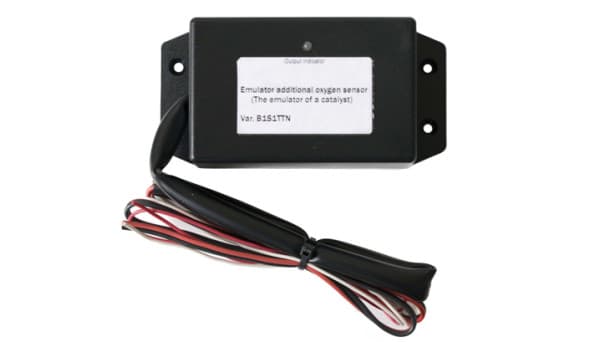
The auxiliary O2 sensor emulator is designed to emulate the signal of a downstream (post-catalyst) 5-volt titanium dioxide O2 sensor by analyzing the signal of the front O2 sensor of the same 5-volt titanium dioxide type.
The emulator fully replaces the signal of the stock auxiliary O2 sensor responsible for monitoring catalytic converter operation, if the converter is not working efficiently, so that the system's O2 sensors can be checked for serviceability.
The device emulates the auxiliary O2 sensor by analyzing the signal of the primary (front, B1S1) O2 sensor. The device emulates the signals of 5-volt titanium dioxide (resistive) sensors used for catalytic converter diagnostics (B1S2). This sensor operates in the range from 0.3 to 4.9 volts and has an inverse dependence of signal voltage on the air-fuel mixture composition, unlike zirconium dioxide 1 volt O2 sensors, A/FRS sensors (Toyota, Lexus) and LAF sensors (Honda, Mazda), which use three signal wires, not counting the heater wires.